
German Adverbs of Time and Frequency
An adverb is a part of speech that modifies adjectives, verbs, or other adverbs. It also provides more information, such as how, when, and to what extent something occurs. The main types of adverbs are adverbs of manner (how), time (when), place (where), frequency (how often), and degree (how much).
But in this article we’re going to talk about adverbs of time and frequency in German. While I was teaching German before, I was kinda astounded that not all people know what adverb is. So if you’ve got more ideas about English grammar, you won’t find German language that difficult.
What are the 10 examples of adverbs of time?
Since I have to mention this before and differentiate adverbs, verbs and adjectives from another, here are some examples of adverbs of time: always, sometimes, rarely, never, today, yesterday, tomorrow, soon, already and still or yet.
Does German have adverbs?
Yes, of course. Like English, German adverbs of time serve the same function, but they differ in their placement within a sentence.
In the next part, you’ll know how to use adverb and its placement in German sentence.
Word Order: Where Do Adverbs of Time Go in German?
German generally follows the Time–Manner–Place (TMP) rule:
Time → Manner → Place
Here’s how that works:
- Time (when?)
- Manner (how?)
- Place (where?)
Time Adverb – Verb – Subject – Object – (rest of sentence)
Or more commonly:
Subject – Verb – Time Adverb – (rest of sentence)
Example Sentences and Why They Work
1. Adverb + Verb + Subject + Object
This is acceptable for emphasis or in conversational style.
- Heute lese ich ein Buch.
(Today read I a book.)
— Puts emphasis on when. - Morgen kauft er ein Auto.
(Tomorrow buys he a car.)
— “Tomorrow” comes first to emphasize when the action happens.
2. Subject + Verb + Adverb + Object
This is the go-to structure in neutral, everyday language.
- Ich lese heute ein Buch.
(I read today a book.) - Er kauft morgen ein Auto.
(He buys tomorrow a car.)
This layout—Subject, then Verb, then Time Adverb—feels natural and sounds like everyday German.
3. Subject + Time Adverb + Verb + Object
This is another common option, especially to spotlight when something happens.
- Ich heute lese ein Buch. (a bit poetic or emphatic)
- Er morgen kauft ein Auto. (less typical, but possible for emphasis)
Why German adverbs are structured this way?
- Highlighting Time
Placing the adverb at the very beginning (Time–Verb–Subject…) places extra weight on when something happens—useful if that moment is important to the message. - Clarity and Flow
The Subject–Verb–Time–Object order is clean and “naturally German”—it feels logical to a German speaker and keeps communication smooth.
Most used German adverbs
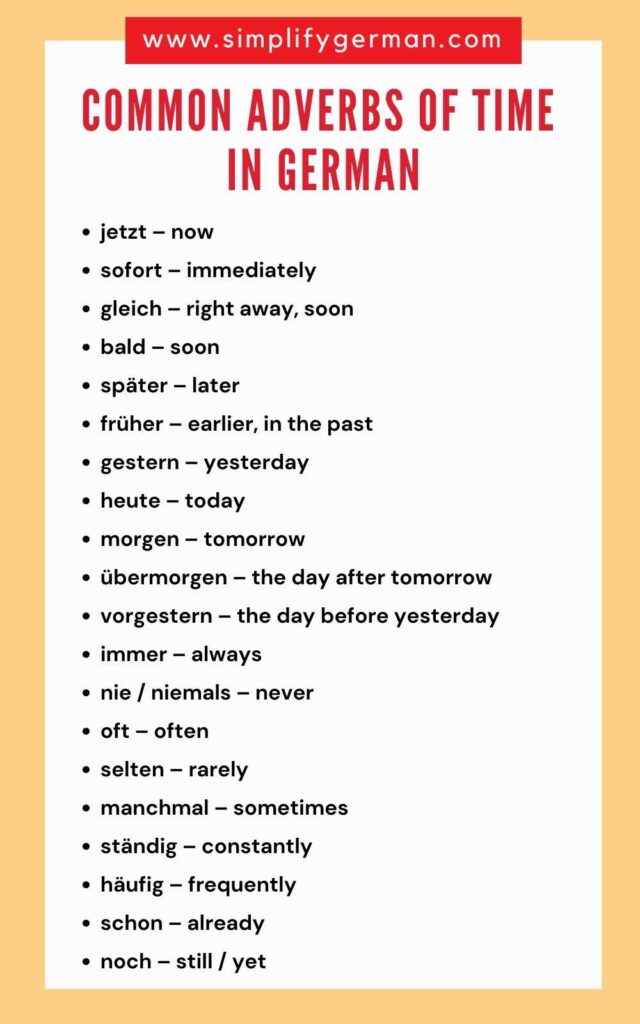
jetzt – now
sofort – immediately
gleich – right away, soon
bald – soon
später – later
früher – earlier, in the past
gestern – yesterday
heute – today
morgen – tomorrow
übermorgen – the day after tomorrow
vorgestern – the day before yesterday
immer – always
nie / niemals – never
oft – often
selten – rarely
manchmal – sometimes
ständig – constantly
häufig – frequently

schon – already
noch – still / yet
noch nicht – not yet
nochmals / wieder – again
endlich – finally
bereits – already
vorhin – a little while ago
eben / gerade – just now
damals – back then, at that time
kürzlich / neulich – recently
zugleich – at the same time
seither – since then
vorher – before, previously
nachher / anschließend – afterwards
demnächst – shortly, soon
German adverbs of time
So here’s a clear grouping of German adverbs of time according to past, present, and future usage:
Past (Vergangenheit)
- gestern – yesterday
- vorgestern – the day before yesterday
- früher – earlier, in the past
- damals – back then, at that time
- vorhin – a little while ago
- eben / gerade – just now
- kürzlich / neulich – recently
- schon – already
- bereits – already
- seither – since then
- vorher – before, previously
Present (Gegenwart)
- jetzt – now
- heute – today
- immer – always
- ständig – constantly
- oft – often
- manchmal – sometimes
- selten – rarely
- nie / niemals – never
- noch – still
- noch nicht – not yet
- wieder / nochmals – again
Future (Zukunft)
- morgen – tomorrow
- übermorgen – the day after tomorrow
- gleich – soon / in a moment
- bald – soon
- später – later
- nachher / anschließend – afterwards
- demnächst – shortly, soon
- endlich – finally
German Adverbs of Frequency
An adverb of frequency tells you how often something happens. In German, these words slide into your sentence to show frequency, just like always, often, sometimes, never do in English.
They don’t change their form. They just drop into the sentence, usually after the verb or before the object.
Common German Adverbs of Frequency

- immer – always
- meistens – mostly, usually
- oft – often
- häufig – frequently
- manchmal – sometimes
- ab und zu – now and then
- selten – rarely
- fast nie – almost never
- nie / niemals – never
Examples
- Ich gehe immer früh ins Bett.
I always go to bed early. - Wir essen meistens zu Hause.
We usually eat at home. - Er kommt manchmal zu spät.
He sometimes arrives late. - Sie liest fast nie Zeitungen.
She almost never reads newspapers.
How to use ‘oft’ in German?
Oft means often. That’s it. Super straightforward.
The only thing you need to keep in mind is where it goes in the sentence. Like most adverbs of time and frequency, it usually sits after the verb or before the object.
1. Subject – Verb – oft – Object
This is the most neutral and common structure.
- Ich lese oft Bücher.
I often read books. - Wir gehen oft ins Kino.
We often go to the cinema.
Here, oft sits right after the verb, before the thing you’re talking about.
2. Time/Place – Verb – Subject – oft – Object
If you shuffle things for emphasis (like starting with time or place), oft still keeps close to the verb or object.
- Am Wochenende gehe ich oft spazieren.
On weekends I often go for a walk. - In Deutschland regnet es oft.
In Germany it often rains.
3. Emphasis by Moving oft
You can put oft a little earlier in the sentence if you want to stress frequency.
- Oft lese ich am Abend.
Often I read in the evening.
This way, the word “often” is front and center, showing how frequent the action is.
What is the comparative form of oft in German?
The word oft (often) has a special comparative form: öfter.
It means more often.
That’s the form you’ll actually hear in daily German.
Examples
- Ich gehe öfter ins Fitnessstudio als früher.
I go to the gym more often than before. - Wir telefonieren jetzt öfter.
We call each other more often now. - Er besucht seine Eltern öfter als seine Schwester.
He visits his parents more often than his sister.
You might also see häufiger used in the same way. It’s basically the comparative of häufig (frequent). The difference is subtle:
- öfter = casual, everyday speech
- häufiger = a bit more formal, used in writing or careful speech
Both work, but öfter is the natural choice when speaking.
What is the superlative form of oft in German?
The superlative is am häufigsten or am öftesten.
Both mean most often.
But:
- am häufigsten is the standard, more common form.
- am öftesten exists, but many Germans find it clunky or avoid it in writing.
Examples
- Von allen Schülern fragt er am häufigsten.
Of all the students, he asks most often. - Sie besucht ihre Großeltern am häufigsten.
She visits her grandparents most often.
Take note
Use öfter for the comparative in everyday German.
For the superlative, switch to am häufigsten — it sounds smoother and more natural than am öftesten.
More Advanced German Adverbs of Time (Temporaladverbien)
Past (Vergangenheit)
- einst – once, at one time
- vormals – formerly
- zuvor – before, previously
- ehedem – in former times (archaic, but used in literature)
- ehemals – formerly, once
- vor kurzem – a short while ago, recently
- vorhin – earlier (today)
- soeben – just (a moment ago)
Examples:
- Einst lebte er in Berlin. – Once he lived in Berlin.
- Zuvor hatte sie in München gearbeitet. – She had worked in Munich before.
- Soeben ist der Zug abgefahren. – The train just left.
Present (Gegenwart)
- gegenwärtig – at present, currently
- momentan – at the moment
- derzeit – at present, currently
- nunmehr – by now, at this point
- zurzeit – currently, at the moment
- fortwährend – continuously
- beständig – constantly, steadily
- augenscheinlich – at the moment, apparently (temporal + modal nuance)
Examples:
- Derzeit wohnen sie in Hamburg. – They currently live in Hamburg.
- Nunmehr ist die Entscheidung endgültig. – By now, the decision is final.
- Er redet fortwährend über Politik. – He talks about politics all the time.
Future (Zukunft)
- inzwischen – meanwhile, in the meantime
- alsbald – shortly, before long
- nachmals – later, afterwards (rare, literary)
- spätestens – at the latest
- künftig – in the future
- zukünftig – future, in the future
- eines Tages – one day, someday
- einstmals – one day, once (literary, poetic)
- über kurz oder lang – sooner or later
Examples:
- Künftig werden wir umweltbewusster leben. – In the future we will live more sustainably.
- Eines Tages wirst du es verstehen. – One day you will understand.
- Spätestens morgen brauche ich die Unterlagen. – I need the documents by tomorrow at the latest.
More adverbs of time according to frequency, quantity and intensity.
Since you already know the adverbs of frequency, I’m now going to show you other adverbs of time, categorized by quantity and intensity. Like other adverbs in a sentence, the rules don’t change.
Frequency (Häufigkeit)
(How often something happens)
- stets – always, invariably
- jedesmal – every time
- mehrmals – several times
- öfter – more often, repeatedly
- bisweilen – at times, occasionally
- ab und zu – now and then
- gelegentlich – occasionally
- zeitweise – at times, temporarily
- hin und wieder – from time to time
- fallweise – in some cases, occasionally (Austrian usage)
Quantity / Extent (Menge, Ausmaß)
(How much or how long in time)

- stundenlang – for hours
- tagelang – for days
- jahrelang – for years
- sekundenlang – for seconds
- unaufhörlich – incessantly, without stopping
- pausenlos – nonstop
- zeitlich unbegrenzt – indefinitely
- zeitlich befristet – temporarily, for a limited time
- dauerhaft – permanently, long-term
- ewig – eternally, forever
Intensity / Emphasis (Intensität, Nachdruck)
(How strongly or emphatically in time)
- schlagartig – suddenly, all at once
- augenblicklich – instantly, in the blink of an eye
- blitzartig – like lightning, very suddenly
- sofortig – immediate, without delay
- plötzlich – suddenly
- unverzüglich – without delay, promptly (formal)
- rasch – quickly, swiftly
- sogleich – immediately, straightaway
- jäh – abruptly, suddenly (literary/formal)
Conclusion
Adverbs of frequency are small words, but they carry a lot of weight. They tell your listener how often something happens, and with them you can make your German sound a lot more natural. Keep in mind the simple placement rule: after the verb, before the object, and you’re set. From immer to nie, these adverbs give your sentences rhythm and clarity.
PIN THIS FOR LATER


