

How To Find Apartment In Germany | What you should know as a foreigner
Clyde, how can I find apartment in Germany? I remember when a friend asked me that.
Heck, that time, I was also looking for an apartment in Berlin.
Whether you are a student, traveler or a working expat moving to Germany, you would need an accommodation where you can sleep, eat and attend to your personal matters.
Want to know the difference between Vermieten and Mieten?
In this blog post, I will share you how I find my own apartment in Berlin where finding any apartment is like Hunger’s Game.
Before we get into details, I show you what to expect in this blog post.
☑️ you will know how to find accommodation in Germany especially if you’ve just arrived
☑️ you will know where and how to find short and long-term apartments in Germany
☑️ you will know if it’s that hard to find accommodation in this country
☑️ you will know if having a job is a requirement in getting an apartment
☑️ you will know the things you would need in getting your own place
☑️ you will know the common terms you’ll encounter finding your own place you can call home
But here’s what I can’t give you, unfortunately:
❌ Your own apartment
Disclaimer Post: This post contains affiliate links. If you click and purchase, I may receive a small commission at no extra cost to you.
How to find accommodation in Germany: Points to consider
Here are more points you need to consider in finding a place to live:
– Know your preference
Do you want to live in a house or in an apartment?
If you’re living in a big city like Berlin, finding a house is a challenge unless you’re prepared to spend more and ready to settle in the outskirt or almost outside of the center of the city.
When considering renting an apartment in Germany, there are several important factors to take into account. Firstly, the location is crucial.
Cities like Berlin, Munich, and Hamburg have different neighborhoods with varying atmospheres and lifestyles.
It is advisable to consider the infrastructure, proximity to public transportation, shopping facilities, and other essential amenities.
Some neighborhoods might be more lively and noisy, while others are quieter and family-friendly. The choice of location heavily depends on personal preferences and needs.
– Know your budget
If you have the money, finding a place to live should not be a problem in Germany.
Falsch.
Some apartment hunters are willing to pay €3000 as a reward if you could successfully find them a flat.
When I knew that thing indeed exists, I thought, these people have money to spend for a 2-bedroom apartment for €1500 in the city and willing to pay extra, but it’s still challenging to get a flat.
But having money puts you at advantage too than having none in your pocket when you have to find a home urgently.
When renting an apartment, you have to consider about paying for the deposit (Kaution) which is usually 2-3 months of the cold rent.
Aside from that, you have to pay for a moving service if you have already settled in Germany and wanted to relocate. A moving service may cost you around €500-1000 depending on the quantity of your stuff and furnitures.
– Duration of your stay
Finding an apartment successfully depends on the duration and the purpose of your stay. Are you here for work or travel?
If you’re here as a tourist, staying for a maximum of 1 week, hotels and AirbnBs are your options.
But for longer stays, I suggest to look for short-term and long-term accommodations.
Short-term accommodations
Short-term rentals offers a temporary solution while navigating the bureaucratic processes often associated with securing a long-term lease in Germany.
Additionally, it alleviates the pressure of making a hasty decision, allowing you to take your time in finding a residence that aligns with your preferences and needs.
Living in a temporary short-term rental allows you to have a smoother transition in the country as a newcomer who’s still unfamiliar with the German housing market.
Short-term apartments are easier to acquire than the long-term ones, even if you’re still abroad you can search for them online and these rentals are usually fully furnished.
Best websites for renting short-term accommodations in Germany:
- WG-Gesucht (www.wg-gesucht.de): While more focused on shared accommodations, WG-Gesucht also lists short-term rentals and sublets.
- HomeToGo (www.hometogo.com): A search engine for vacation rentals that aggregates listings from various platforms, making it easier to compare options.
- Fewo-direkt (www.fewo-direkt.de): Translated as “holiday home directly,” this platform offers vacation rentals, including short-term apartment rentals.
- 9flats (www.9flats.com): Similar to Airbnb, 9flats allows individuals to rent out their homes or rooms for short-term stays.
- Wimdu (www.wimdu.com): Another platform that connects travelers with hosts offering short-term rentals and vacation homes.
- Uniplaces (www.uniplaces.com): Initially focused on student housing, Uniplaces has expanded to offer short-term rentals for a broader audience.
- Homelike (www.thehomelike.com): Primarily targeting business travelers, Homelike provides furnished apartments for short and mid-term stays.
- Nestpick (www.nestpick.com): Offers a range of furnished apartments, including short-term rentals and extended stays.
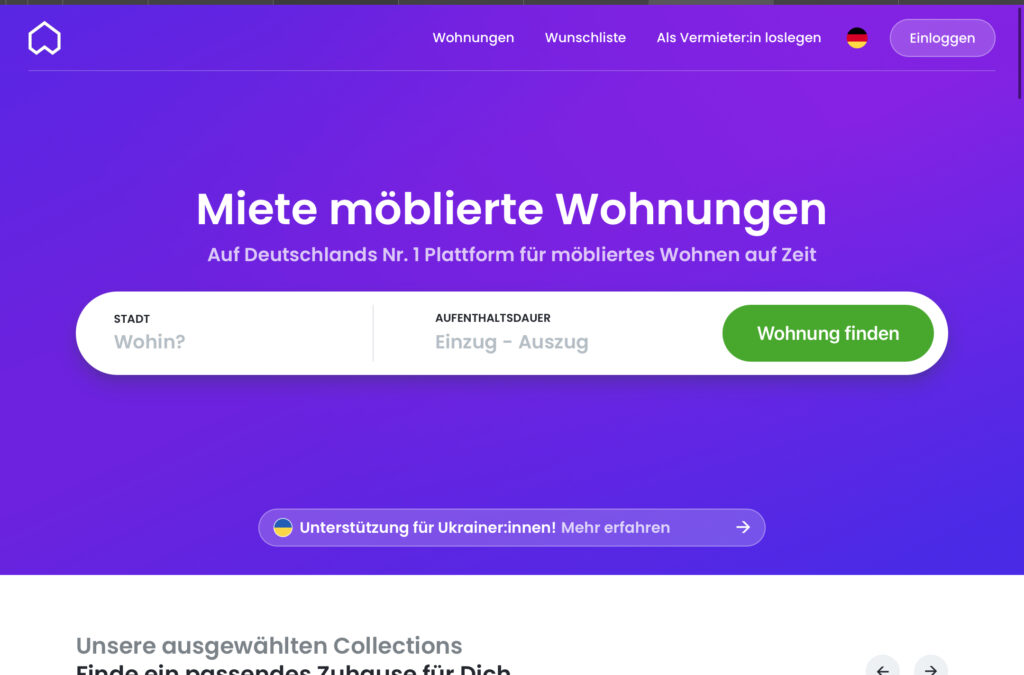
- Wunderflats (www.wunderflats.com): German platform for short-term furnished rentals. It connects users with quality, fully furnished apartments, offering a hassle-free solution for temporary stays and business trips in Germany.
- Smartments (www.smartments-business.de):Offers smart living solutions with short-term furnished rentals and modern and well-designed apartments in top cities like Berlin and Munich.
- HousingAnywhere (www.housinganywhere.com): Enables users to find and secure short-term rentals in various cities worldwide, fostering a seamless and secure cross-border housing experience. Visit their website for a user-friendly interface, transparent booking processes, and a diverse range of listings, making HousingAnywhere a distinctive and reliable option for those seeking short-term rentals with an international focus.

Long-term Accommodations
Committing to a long-term lease often provides a sense of stability and security, allowing you to to establish a more permanent residence.
This can be particularly beneficial if you’re planning to stay in Germany for an extended period, if you are a student pursuing a degree or a working professional.
Long-term rentals typically offer cost savings compared to short-term options, providing a more economical solution in the long run.
Best websites for renting long-term accommodations in Germany:
Foto von Johannes Schenk auf Unsplash
- Immobilienscout24 (www.immobilienscout24.de): One of the largest real estate platforms in Germany, offering a wide range of long-term rental listings.
- WG-Gesucht (www.wg-gesucht.de): While it primarily focuses on shared accommodations, WG-Gesucht also lists long-term rentals and apartment shares.
- Immonet (www.immonet.de): Another major real estate portal in Germany with a variety of long-term rental listings.
- Ebay Kleinanzeigen (www.ebay-kleinanzeigen.de): The classifieds section of eBay in Germany often includes listings for long-term rentals posted by private individuals.
- HomeCompany (www.homecompany.de): Specializing in furnished and unfurnished rentals, HomeCompany is known for its long-term accommodation options.
- Immowelt (www.immowelt.de): A comprehensive real estate platform with various long-term rental listings across Germany.
- Nestoria (www.nestoria.de): An online search engine that aggregates long-term rental listings from various sources, making it easier to find suitable options.
- StudiVZ (www.studivz.net): Initially a social network for students, StudiVZ also features a housing section with long-term rental listings.
- MieterEngel (www.mieterengel.de): While primarily focused on tenant rights, MieterEngel also provides a platform for long-term rentals.
- Berlinovo (www.berlinovo.de): A platform offering long-term rentals, particularly in the Berlin area.
- Facebook groups: If you are a Facebook user, you can find a number of Facebook groups dedicated for apartment hunting and offers —beware of the scams though.
Requirements in finding an apartment in Germany
The German rental market is known for its meticulous standards and you as a future tenant need to be well-prepared in fulfilling their bureaucratic terms.
From financial documentation to understanding local customs, being well-versed in the requirements is crucial for securing a desirable and sustainable living arrangement.
Below is a list of key prerequisites for finding an apartment in Germany:
- SCHUFA Credit Report
- A SCHUFA credit report is a crucial document that provides a comprehensive overview of an individual’s credit history. Landlords often request this report to assess the tenant’s financial reliability and ability to meet rental payments.
- Proof of Income:
- Providing proof of income at least for the last 3 months, such as pay stubs or employment contracts, assures landlords of the tenant’s financial stability and capacity to cover rent and living expenses.
- Rental References:
- Letters of recommendation from previous landlords or property managers serve as valuable references, offering insights into a tenant’s past rental behavior and reliability. This is not a must-have but will be an advantage if you have one.
- Mietschuldenfreiheitsbescheinigung (Rent Debt-Free Certificate):
- This certificate attests that the tenant has no outstanding rental debts. It is often required to demonstrate a responsible rental history.
- Schufa Mieterauskunft (Tenant Credit Check):
- Similar to the SCHUFA credit report, the Schufa Mieterauskunft provides landlords with information about the tenant’s creditworthiness, helping them assess the risk of renting to a particular individual.
- Anmeldung (Registration):
- Registering your address (Anmeldung) with the local authorities is a legal requirement in Germany. A confirmation of registration is often requested during the rental application process.
- Valid Passport or ID:
- A valid passport or national ID is essential for identity verification and is typically required when signing a rental agreement.
- Proof of Liability Insurance:
- Liability insurance (Haftpflichtversicherung) is recommended and may be required by some landlords. It offers protection in case of accidental damage to the rented property.
- Kaution (Security Deposit):
- The Kaution is a security deposit, usually equivalent to three months’ rent, held by the landlord as a precaution against potential damages or unpaid rent. Some landlords would ask you to open a bank account for the security deposit (Mietkautionskonto). If you have a bank account already, you can ask your bank to open it for you like I did on Sparkasse.
Related Questions About Finding Your Place in Germany
❇️ Is it really hard to find accommodation in this country?
The demand for accommodation in Germany, particularly in major cities, often exceeds the available supply.
This high demand can result in a competitive and sometimes challenging housing market, where individuals may face difficulties finding suitable and affordable housing.
Factors such as a growing population, student influx, and economic opportunities contribute to the tight housing market.
Additionally, certain cities, like Berlin and Munich, are known for their competitive rental landscapes, making it important for individuals to be proactive, well-prepared, and flexible in their search for accommodation.
❇️ Can I rent in Germany without a job?
Renting an apartment in Germany without a job can be challenging, as landlords often require proof of income or financial stability. Having a reliable source of income, a guarantor (Bürgschaft), or a substantial savings account can improve your chances of securing a rental.
Terms and Words You Should Know in German Rental Market
- Suchen – To search
- Mieten – To rent
- Vermieten – To lease/rent out
- Besichtigen – To view/inspect (an apartment)
- Bewerben – To apply
- Anmelden – To register
- Kündigen – To terminate/cancel (a lease)
- Umziehen – To move (residence)
- Einziehen – To move in
- Auszug – Move-out
- Einzug – Move-in
- Kaution zahlen – To pay the security deposit
- Mietvertrag – Rental agreement/contract
- Makler – Real estate agent/broker
- Genossenschaft – Housing cooperative
- Nebenkosten – Additional costs/utilities
- WG (Wohngemeinschaft) – Shared apartment/flat (colloquially called a “WG”)
- Exposé – Property listing
- Kaltmiete – Base rent (excluding utilities)
- Warmmiete – Rent including utilities
- Annonce – advertisement
- Hausverwaltung – property management
More Tips in Finding Accommodation in Germany
- When you’re desperate to find a place to stay, you won’t think of any danger anymore. I advise you against sending any personal documents without making sure that the apartment ad is legit.
- Don’t send money if you haven’t seen the rental place yet, talked to the owner or property manager, got the approval and saw the contract. Sending money usually happens through bank transfer and not through cash.
- If possible, take somebody with you when you’re visiting the place you wanted to rent for your safety.
- When writing for your application especially on Ebay-kleinanzeigen, be polite and greet the person who posted the advertisement.
In a Nutshell…
Remember, patience and persistence pay off in this exciting journey. Don’t hesitate to immerse yourself in the local community, ask questions, and explore different neighborhoods.
Whether you’re navigating the paperwork, meeting potential flatmates, or enjoying the thrill of finding your new home, savor every moment.
Viel Erfolg! 🏠✨